
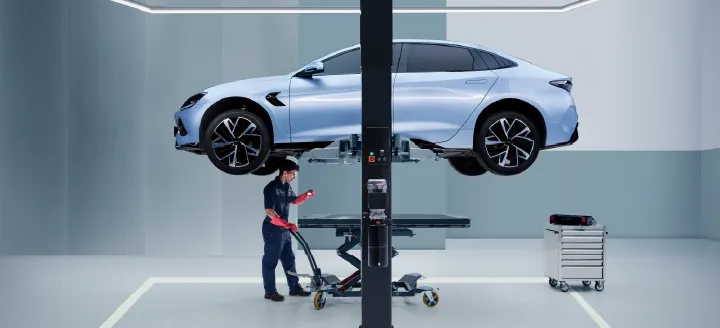

The listed price of a used BYD part is only the first line of the repair bill. The real comparison is what each sourcing route commits the owner to: the shop’s itemized quote with its parts markup and warranty terms, or a lower sticker price with the risk carried personally. A cheap part can still produce an expensive repair once labor, freight and downtime are counted.
What the two routes actually cost
A workshop that sources a part adds a markup to cover procurement time and administration, and shops price sourcing and fitting differently. That loading also buys services most owners never see itemized: fitment checks, freight arrangements, returns handling and warranty administration. Written quotes from each shop are the only reliable way to compare what the loading adds in dollars.
Buying direct from an auto dismantler removes the markup entirely. The owner pays the listed price, plus freight, plus the hours spent verifying the part. The saving is real, but so is the work that replaces it.
Put the two routes side by side and the difference comes down to who carries the risk. The shop route bundles the part and the risk into one invoice with one party accountable. The DIY route unbundles them, and every unbundled task lands on the owner.
Shops buy from dismantlers too, and the same used part can appear on a workshop invoice with the loading applied. Asking for the part and the fitting as separate lines shows how much of the bill is the component and how much is everything around it.
Verifying fitment and handling a return can run to hours on a single part, and those hours have value even though no invoice captures them.
Shop sourcing favors owners who want a single point of accountability. Direct sourcing favors owners with time and enough mechanical literacy to verify what they’re buying.
What the warranty trade-off commits you to
The labor warranty is where the two routes diverge most. When a shop sources a part and that part fails, some shops refit a replacement at their own cost, but the scope varies between workshops. Ask for the warranty terms in writing before committing.
Customer-supplied parts change that arrangement. Some workshops will fit them, with the labor warranty limited to the fitting work. If the part itself proves defective, the owner may have to pay for removal and refitting. Without cover for refitting, a failed part can leave the owner paying for the job twice. Some owners can absorb that. Owners who rely on the vehicle daily usually can’t. A failed part also means downtime while a replacement is sourced, which compounds the labor bill with days off the road.
Policies differ between workshop types. Some dealership service centers refuse customer-supplied parts, particularly on newer vehicles. Ask independent workshops what they will fit and which work they cover.
Used-part warranties from dismantlers, where offered, generally cover the component itself. They rarely stretch to the labor needed to swap it out. Read the terms before assuming otherwise.
Wait times: new parts versus local salvage
New OEM components for recent models may need to come from overseas, and backorders can extend delivery times.
The delay hits dealerships and independent workshops alike. For newer models such as the BYD Shark and BYD Sealion, ask how long the specific part will take to arrive. A single panel on backorder can keep a car off the road.
Salvaged parts sit at the other end of the timeline. Auto dismantlers strip written-off and end-of-life vehicles, so the components are already in circulation rather than on a production line. A local operator offering BYD Wrecking is a reasonable starting point for research, and the question to ask any dismantler is direct: is the part on the shelf, and when can it ship?
Local availability is one reason workshops buy through dismantlers themselves. Off-road time carries its own cost, and hire cars and missed work add up while a container sits at sea. A part that arrives this week at a modest premium can total less than a cheaper one that arrives next month.
Parts you can source yourself, and parts best left to the shop
Given both costs, the practical split runs along technical complexity. Cosmetic and simple bolt-on components are easier to source yourself. Start with parts whose condition you can inspect and whose fitment you can verify, such as interior trim or a plain tailgate panel.
A door that arrives with the wrong trim insert can cost time and freight to exchange. Interior parts are similarly forgiving, because wear is easy to judge from photos and fitment rarely depends on electronics.
Mirrors and bumpers sit one step up. Both can house cameras and parking sensors on current BYD models, so a clean-looking unit may still carry electronics that need matching and setup.
Complex electrical work belongs with the shop. So do suspension parts and anything integrated with driver-assistance systems. The same applies to any work adjacent to the battery pack, where a qualified workshop should assess the scope before anything is ordered or fitted.
The split is also about where the consequences land. A mis-specified trim panel costs an afternoon. A mismatched sensor or suspension component can compromise safety and add to the labor bill.
The calibration cost that follows the part
Depending on the model, BYD bumpers and grilles can house radar modules and cameras for advanced driver-assistance systems (ADAS). Replacing the panel is only half the job.
Whether the system then needs recalibration is the workshop’s call, made from the manufacturer’s instructions for the actual repair. Some jobs call for diagnostic equipment that most home garages don’t have, and a genuine part fitted perfectly can still throw warning lights and faults until that work is done. Where calibration is required, the car’s safety features depend on it.
This narrows the DIY saving considerably. The owner can still buy the part direct and avoid the markup, but the calibration labor stays with the workshop regardless. The saving is confined to the part line, not the whole job.
Get the calibration quote before buying the part. Some shops quote calibration as a fixed item; others fold it into a larger diagnostic bill. Knowing that figure up front shows whether the direct-buy saving holds once the total invoice is assembled.
Freight and the hidden cost of bulky parts
Even a well-chosen part has to survive the trip. Doors, hoods, tailgates and subframes don’t travel like parcels. They need specialized freight with protective packing, and retail buyers pay one-off rates for it.
Ask whether the dismantler can photograph the part before dispatch. Repair shops may have access to commercial freight rates. Ask how the shop handles a panel that arrives damaged.
On a retail order, ask the dismantler who handles a freight damage claim. Local pickup, where the dismantler allows it, removes the freight line entirely and lets the owner inspect the part before paying.
Freight can quietly erase the markup saving on large items. Price it before committing, and ask who carries the risk while the part is on the truck.
Checking authenticity, grading and fitment
Verification happens before money changes hands. Reputable dismantlers match parts by VIN, which pins the component to the exact trim level and build date of the donor vehicle. BYD’s running changes between model years can alter mounting points and electrical connectors, so a part from the wrong build can refuse to fit.
Ask for the donor vehicle’s build details and the part’s grade, backed by photos of the actual item. If a dismantler uses letter grades, ask what each grade means and what wear or damage it allows for.
A Grade B door at a lower price often makes more sense than a Grade A one on a daily-driven car. Where a part number is visible, match it against the old component before the old one leaves the car. Keep the invoice and the stated grade in writing, because both matter if the part needs to go back.
Check the part number against your own vehicle so you can account for differences in model year and trim.
The environmental case for used parts
Every salvaged panel reused is one fewer manufactured from raw material. Auto dismantling keeps high-grade metals and plastics in circulation and out of landfill, and it cuts the industrial demand that new-part manufacturing carries.
For EV owners, the logic extends the reason many bought the car in the first place. Lower footprint in use, lower footprint in repair.
The Right to Repair movement pushes in the same direction. Its core claim is that owners should be free to choose cost-effective parts and independent repairers, and used OEM components sit at the center of that choice.
How to split the difference
The decision works part by part. Consider sourcing simple bolt-ons directly, such as plain tailgate panels and trim, after confirming fitment and condition in writing. Let the shop source anything electrical or ADAS-integrated, along with suspension components, where its labor warranty and calibration equipment earn the markup.
Before buying anything, get two numbers in writing: the shop’s policy on customer-supplied parts, and its price to fit and calibrate the part in question. Then compare like with like. Wrecker price plus freight plus fitting plus calibration, set against the shop’s single quote. If the two totals land close together, the warranty usually decides it.
Some repairs will favor the owner’s own legwork. Others will favor paying the markup and keeping one accountable party. Pricing both routes before choosing either is how owners end up with the better deal.
